Context
Technical work is often ephemeral, especially when projects pile up. Amid daily commits, the "why" behind decisions and the nuances are frequently lost. EchoForge was designed to solve my problem. It serves as a personal repository for technical achievements, intended to transform raw weekly logs into a structured, searchable knowledge base.
The project addresses a core problem: the friction of documentation. By adopting a hybrid AI Agent documentation approach and reporting to an offline database, EchoForge ensures that technical reflections are captured and preserved without cloud or centralized platforms.
The Workflow: Weekly Archiving
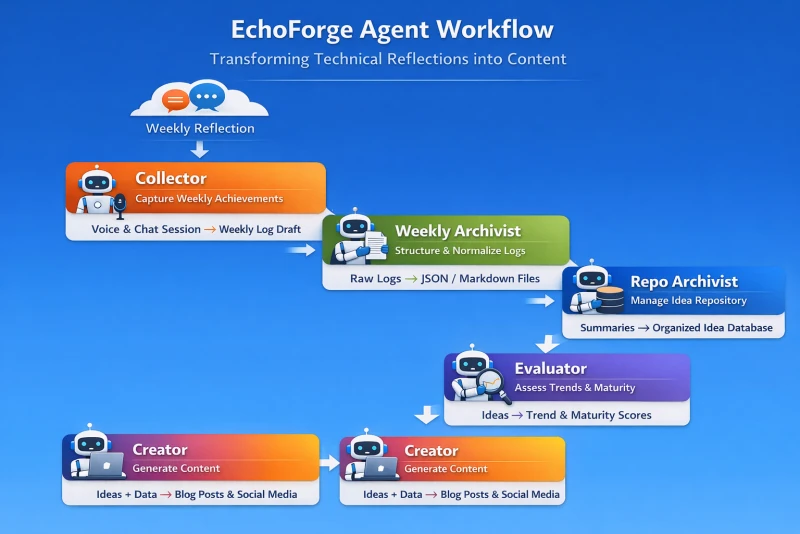
EchoForge's architecture is centered on a recurring weekly cycle. Rather than a manual journal, the user relies on AI agents specialized in discussion, information gathering, summarization, and formatting.
Structured Capture
The flow begins with a Collector agent that captures raw thoughts — often via voice recognition or informal chat. This unstructured data is then passed to the Weekly Archivist, which normalizes the input according to a strict JSON/Markdown schema. Each week of work is thus stored with consistent metadata, including:
- Experiences: Successes, failures, and "pivot" moments
- Achievements: Quantifiable technical wins
- Reflections: High-level learnings on architecture or system logic
Repository Management
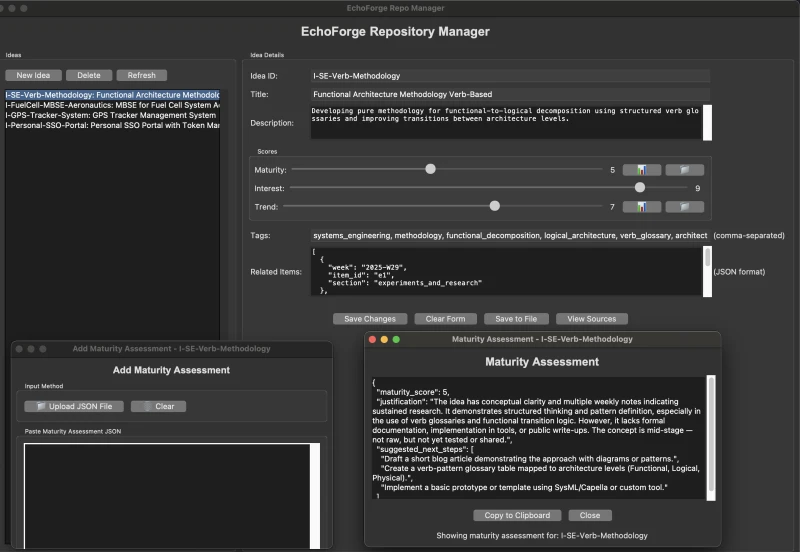
To manage this growing base, I developed the Repo Manager, a Python GUI. It allows local CRUD operations on the idea repository, linking each concept to its weekly source files. This creates a traceable knowledge graph where every blog post or project idea is anchored in real work.
Agentic Intelligence and Transformation
EchoForge is not just storage; it is a search and evaluation engine. It uses an agentic pipeline to evaluate and reuse stored information.
- The Evaluator: This agent analyzes the repository to assess the "maturity" of ideas and their alignment with market trends, helping prioritize concepts to develop
- The Creator: Once an idea is selected, this agent drafts technical content — from LinkedIn posts to in-depth articles — drawing on structured weekly logs as the source of truth. This avoids "AI hallucinations" by grounding the output in the user's actual documented history
Technical Design and Privacy
A non-negotiable constraint for EchoForge was data sovereignty. The entire system is designed to run locally:
- Storage: Plain-text Markdown and JSON files ensure long-term portability and readability
- Security: No API key is required for the core system, and no data is sent to the cloud for storage
- Modularity: Agent prompts and repository structures are decoupled, allowing easy updates to the underlying LLM logic without database migration
Takeaway
EchoForge is a personal infrastructure project that bridges the gap between doing the work and documenting it. By automating the "boring" parts of knowledge management — structuring, tagging, evaluation — it allows the engineer to focus on the high-level synthesis of their own experiences. It turns a silent history of work into a loud, persistent echo of professional growth.


